

MONOMOON hands you a map early on and then expects you to actually understand it, and that’s where a lot of players stall. This short guide covers the two pieces that trip people up: the coordinate grid, and the ten number symbols the game uses everywhere. If you’ve been squinting at the map wondering where you are, or you’ve found a page number in a book and couldn’t read it, this is the part worth pinning down.
What pushed me to write it out is that neither system is explained plainly in-game — you get an interface and a set of glyphs and you either spot the pattern or you don’t. Once you see that the symbols are just digits, the whole thing clicks. So below I’ve laid out the map coordinates first, then the number reading, in the order I’d walk through it.
Reading the Map Coordinates
The map unlocks at the start of the game, and its coordinate system is usable from that moment — you don’t have to wait. On the top edge of the map there’s a moon. Light it up and the coordinates of the cell you’re currently standing in will show along the bottom edge of the map. From then on you always know exactly where you are, provided you can read the symbols — which is exactly what the second half of this guide is for.
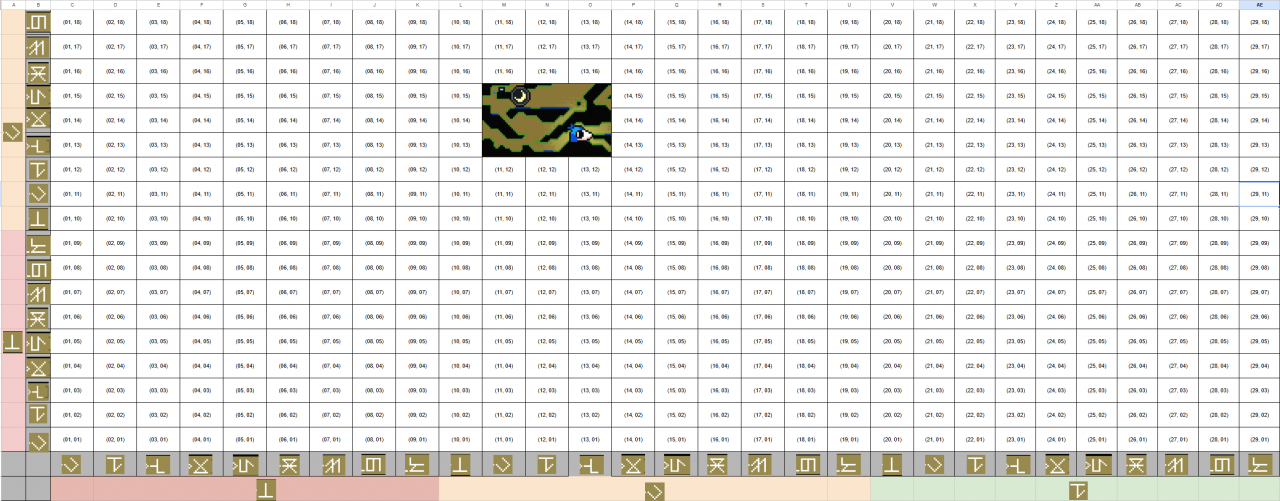
The grid itself is 29 × 18 cells, and each cell is identified by a pair of numbers written as (X, Y). Here’s how the two axes work:
- X = column, running from 01 to 29, counting left to right
- Y = row, running from 01 to 18, counting bottom to top
So the bottom-left cell is (01, 01) and the top-right is (29, 18). The one thing I’d watch for is that Y counts upward, not downward like you might expect from reading top to bottom — if your coordinates feel “off,” check that first.

Below is the full grid with every coordinate written out, which is handy to keep beside you while exploring:
The Symbols Are Just Digits
This is the part that unlocks everything else. The game uses ten symbols, and they’re simply the digits 0 through 9. Those same symbols turn up elsewhere too — the book’s page numbers use them, so learning them pays off beyond the map.

Every number is written using two symbols: the first is the tens digit, the second is the units digit. Put the two together and you have the full number. A few examples to make the pattern stick — 1 followed by 4 reads as 14, 2 followed by 0 reads as 20, and 0 followed by 7 reads as 07.
Once those two-symbol pairs become second nature, the map and the book numbers stop being puzzles. Happy exploring. 🌙