

If you’re building a character in Pool of Radiance: Ruins of Myth Drannor and wondering why the game won’t let you pick your own feats, this breakdown is for you. Below I’ve laid out the automatic feat and skill choices every class receives as it levels up, so you can plan your build around what the game actually hands you instead of fighting it.
I put this together because the fixed progression is genuinely frustrating — especially if you’re trying to run an archer or another build that leans hard on specific feat picks. Once you know the exact order things unlock, you can decide whether a class will actually support the character you want before you sink hours into it.
How the Automatic Progression Works
The core problem is simple: character creation doesn’t let you choose skills or feats. Every class follows a fixed schedule, and the game picks for you. That matters most for builds where feat choice is everything — archers being the obvious example, since ranged feats like Point Blank Shot and Precise Shot land at different points depending on your class.
One thing worth noting before you dig into the tables: some skills are universal and show up across every class. Heal, Search, Spot, and Listen appear on every single class list below, so you can count on those regardless of what you roll.
Class Skills at a Glance
Here’s the skill list each class draws from. Notice how the martial classes stick to the universal four while casters and rogues branch out.
| Class | Class Skills |
|---|---|
| Barbarian | Heal, Listen, Search, Spot |
| Cleric | Concentration, Heal, Listen, Search, Spellcraft, Spot |
| Fighter | Heal, Listen, Search, Spot |
| Monk | Heal, Listen, Search, Spot |
| Paladin | Concentration, Heal, Listen, Search, Spot |
| Ranger | Concentration, Heal, Listen, Search, Spot |
| Rogue | Disable Device, Heal, Hide, Listen, Move Silently, Open Locks, Search, Spot |
| Sorcerer | Concentration, Heal, Listen, Search, Spellcraft, Spot |
Feat Progression by Class
Each entry below lists the feat granted at that level number. I’ll walk through them class by class so you can trace exactly when a key feat arrives for your build.
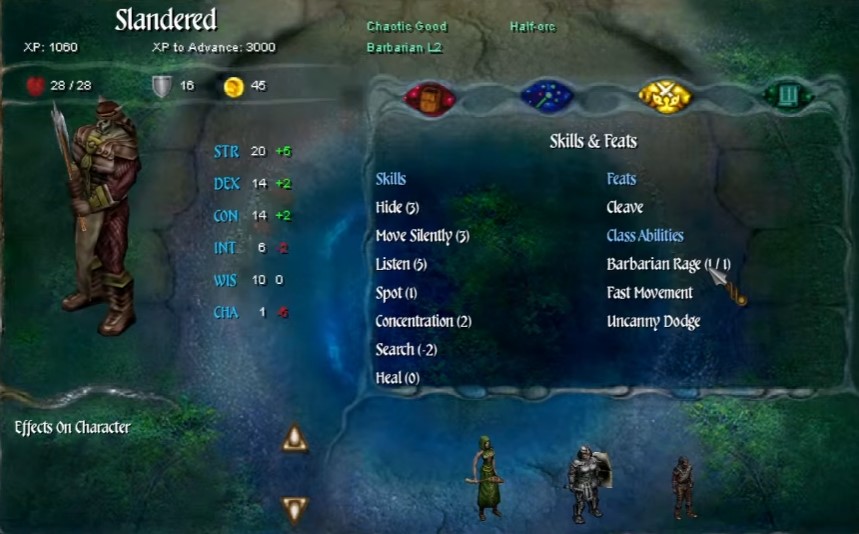
Barbarian
The Barbarian opens with Cleave right at 1st level, which is a strong start if you like cutting through groups. Here’s the full schedule:
- Cleave
- Run
- Improved Initiative
- Mobility
- Improved Critical
- Power Attack
- Combat Reflexes
- Blind-Fight
- Great Fortitude
- Lightning Reflexes
- Iron Will
- Point Blank Shot
- Precise Shot
- Skill Focus
- Toughness
Cleric
Clerics get Extra Turning at 1st, then settle into a mix of casting and combat feats. This is one of the longer progressions, running all the way to 18th:
- Extra Turning
- Combat Casting
- Skill Focus
- Spell Penetration
- Great Fortitude
- Power Attack
- Iron Will
- Improved Critical
- Lightning Reflexes
- Improved Initiative
- Cleave
- Toughness
- Combat Reflexes
- Mobility
- Run
- Point Blank Shot
- Precise Shot
- Blind-Fight
Fighter
Fighters get Power Attack first, then Improved Critical at 2nd — a nice early pairing. The full list:
- Power Attack
- Improved Critical
- Lightning Reflexes
- Combat Reflexes
- Cleave
- Iron Will
- Blind-Fight
- Run
- Point Blank Shot
- Improved Initiative
- Great Fortitude
- Precise Shot
- Mobility
- Skill Focus
- Toughness
Monk
The Monk starts with Combat Reflexes, then follows a steady defensive and mobility path. Here’s the order:
- Combat Reflexes
- Iron Will
- Improved Critical
- Run
- Lightning Reflexes
- Great Fortitude
- Improved Initiative
- Blind-Fight
- Mobility
- Skill Focus
- Power Attack
- Cleave
- Point Blank Shot
- Precise Shot
- Toughness
Paladin
Paladins lead with Improved Critical and tack on Combat Casting at 4th, balancing their martial and divine sides. The progression reaches 17th:
- Improved Critical
- Power Attack
- Iron Will
- Combat Casting
- Skill Focus
- Blind-Fight
- Great Fortitude
- Cleave
- Spell Penetration
- Lightning Reflexes
- Improved Initiative
- Combat Reflexes
- Mobility
- Point Blank Shot
- Precise Shot
- Run
- Toughness
Ranger
This is the class that actually rewards an archer build early — the Ranger gets Point Blank Shot at 1st and Precise Shot at 3rd. If ranged combat is your goal, that early access is exactly why the Ranger stands out. Full schedule:
- Point Blank Shot
- Mobility
- Precise Shot
- Improved Initiative
- Great Fortitude
- Run
- Combat Reflexes
- Power Attack
- Blind-Fight
- Cleave
- Improved Critical
- Combat Casting
- Lightning Reflexes
- Iron Will
- Skill Focus
- Spell Penetration
- Toughness
Rogue
The Rogue opens on Skill Focus, and worth flagging here: the list skips 13th level entirely and stops at 15th. Don’t assume something went missing on your screen — that’s just how it runs. The order:
- Skill Focus
- Improved Initiative
- Mobility
- Combat Reflexes
- Toughness
- Point Blank Shot
- Lightning Reflexes
- Improved Critical
- Precise Shot
- Blind-Fight
- Iron Will
- Great Fortitude
- Run
- Cleave
Sorcerer
Sorcerers start with Toughness — a small survivability cushion for a squishy caster — then move into spell-focused feats like Spell Penetration at 2nd and Combat Casting at 3rd. The full run to 17th:
- Toughness
- Spell Penetration
- Combat Casting
- Lightning Reflexes
- Iron Will
- Mobility
- Improved Initiative
- Skill Focus
- Great Fortitude
- Run
- Point Blank Shot
- Precise Shot
- Combat Reflexes
- Blind-Fight
- Power Attack
- Improved Critical
- Cleave
Conclusion
Since the game locks in these feats and skills for you, the smart move is to pick a class whose automatic path already matches the build you’re imagining — rather than grinding toward a feat that shows up far later than you need it. If you spot anything that doesn’t line up with your own runs, keep it handy and adjust as you learn the game.